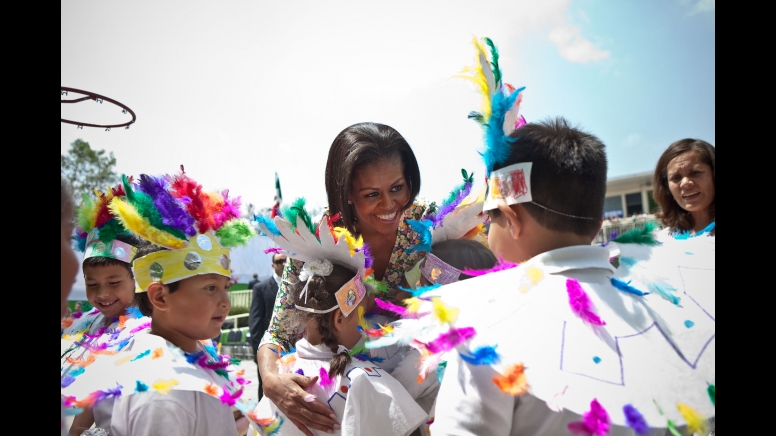
First Lady Michelle Obama greets children during her visit to a school, Escuela Siete de Enero, in Mexico City, Mexico, April 14, 2010. (Official White House Photo by Samantha Appleton)
The book reveals friction on a number of issues between First Lady Michell Obama and former White House Chief of Staff Rham Emanuel, including immigration. Via The Huffington Post:
That revelation is one of the more explosive included in “The Obamas,” a new book by Jodi Kantor of The New York Times about the first few years of the Obama administration and the strains that it produced on the president’s marriage — strains that were ultimately overcome.
[…]
According to Kantor, in the lead-up to the 2010 midterm elections Emanuel and Michelle Obama were at odds over whether the president should give an address on the need for comprehensive immigration reform. The president wanted to do it. The chief of staff saw no point in pushing for legislation that had no chance of passage. The first lady, who had just been confronted by a second-grader in a Maryland elementary school whose mother didn’t have immigration papers, felt that ignoring the issue was fundamentally at odds with her husband’s own political story.
The Obamas won out. The president ended up writing portions of the speech himself but it ended poorly.
“His impassioned remarks faded almost as soon as he gave them,” writes Kantor. “The media and others were puzzled — why this, why now? … Obama became quietly furious at his team for not giving the address more support, for not delivering the one he had wanted in the first place or talking it up more in the press. The first lady fumed, too: she took it as more proof that her husband’s advisers were poorly serving him. … The speech incident confirmed her worst fears, and by that point, several aides said, Michelle was bluntly telling her husband that he needed a new team.”
The Huffington Post also has this interesting bit: apparently Hillary Clinton had also had confrontations with Rham Emanuel when she was a first lady herself:
“Michelle and Rahm Emanuel had almost no bond; their relationship was distant and awkward from the beginning. She had been skeptical of him when he was selected, and now he returned the favor; he was uneasy about first ladies in general, several aides close to him said, based on clashes with Hillary Clinton in the 1990s that became so severe that she had tried to fire him from her husband’s administration,” writes Kantor. “Now Emanuel was chief of staff, a position that almost never included an easy relationship with the first lady. They were the president’s two spouses, in a sense, one public and official and one private and informal.”
This seems to validate the criticisms that many immigrant rights activists across the country have been voicing for months now. The criticism being that whoever had been advising President Obama on immigration policy had been doing a poor job at it, evidenced by the wrong headed focus on escalation of deportations instead of more executive orders to provide administrative relief to immigrants. We have seen some shift on this but the jury is still out on whether new prosecutorial discretion rules (known as the “Morton Memo“) are even being followed by ICE, paricularly with DREAM Act eligible cases. However, the hope is that the President will continue to realize that he must exercise more of his executive powers to break the gridlock on much needed action to keep families together instead of deporting them. There are some encouraging signs, like the proposal just announced by the Obama administration for a new process allowing spouses and children of US citizens to file for visas while remaining in the country instead of forcing them to leave in order to do so. One thing is to propose and announce a new policy, of course, and another is the actual application of it … so we’ll be monitoring just how much change actually takes place.
Here’s the analysis of the immigration speech President Obama gave that the book references.
Here’s also what Project Economic Refugee wrote on the person that eventually replaced Rham Emanuel, Mr. William Daley.
Read more on the new ‘The Obamas’ book on MSNBC.
Update: so far I’ve read that the new proposed waiver would allow children and spouses of U.S. citizens stay in the country while they process their visas but what about PARENTS of U.S. citizens? Woud this new waiver also apply to parents? Does anyone know?
Update # 2: Also check out the video of First Lady’s remarks during her visit to Mexico City pointing out how Mexico is home to more U.S. citizens than any other country: